Most people start this process by Googling a number and end up more confused than when they began, because the answers swing from "AED 50,000" to "the sky's the limit" and neither one helps you plan your home. So let's do this properly. The honest answer is that an interior design budget in Dubai is less about one figure and more about a set of decisions, and once you understand those decisions you can build a number that fits your home and your life rather than someone else's.
Here's the useful truth up front: you have far more control over the cost than you think. Two homeowners with the same villa, in the same community, can spend wildly different amounts and both end up with a home they love. The difference isn't luck or income. It's how clearly they decided what mattered, and how well someone managed the money against those decisions. This article is about how to make those decisions on purpose.
Why interior design in Dubai costs what it costs
A few things shape the price here, and none of them are mysterious once you see them.
A lot of what goes into a home gets imported, so furniture, stone, and fittings carry shipping and lead times on top of the sticker price. The work itself is done by proper trade crews rather than a single handyman, so a real fit-out involves a joinery workshop, an electrician, a painter, and an installation team, each with a rate. And Dubai homes tend to be large, so there's simply more floor, wall, and ceiling to design and finish than the apartment you might be picturing.
The cost people never see coming is coordination. Getting a dozen suppliers to deliver the right thing, to the right home, in the right week, is the genuinely hard part. Projects rarely go over budget because a sofa was expensive. They go over because nobody owned the schedule, and time in this business is money.
Where the money actually goes
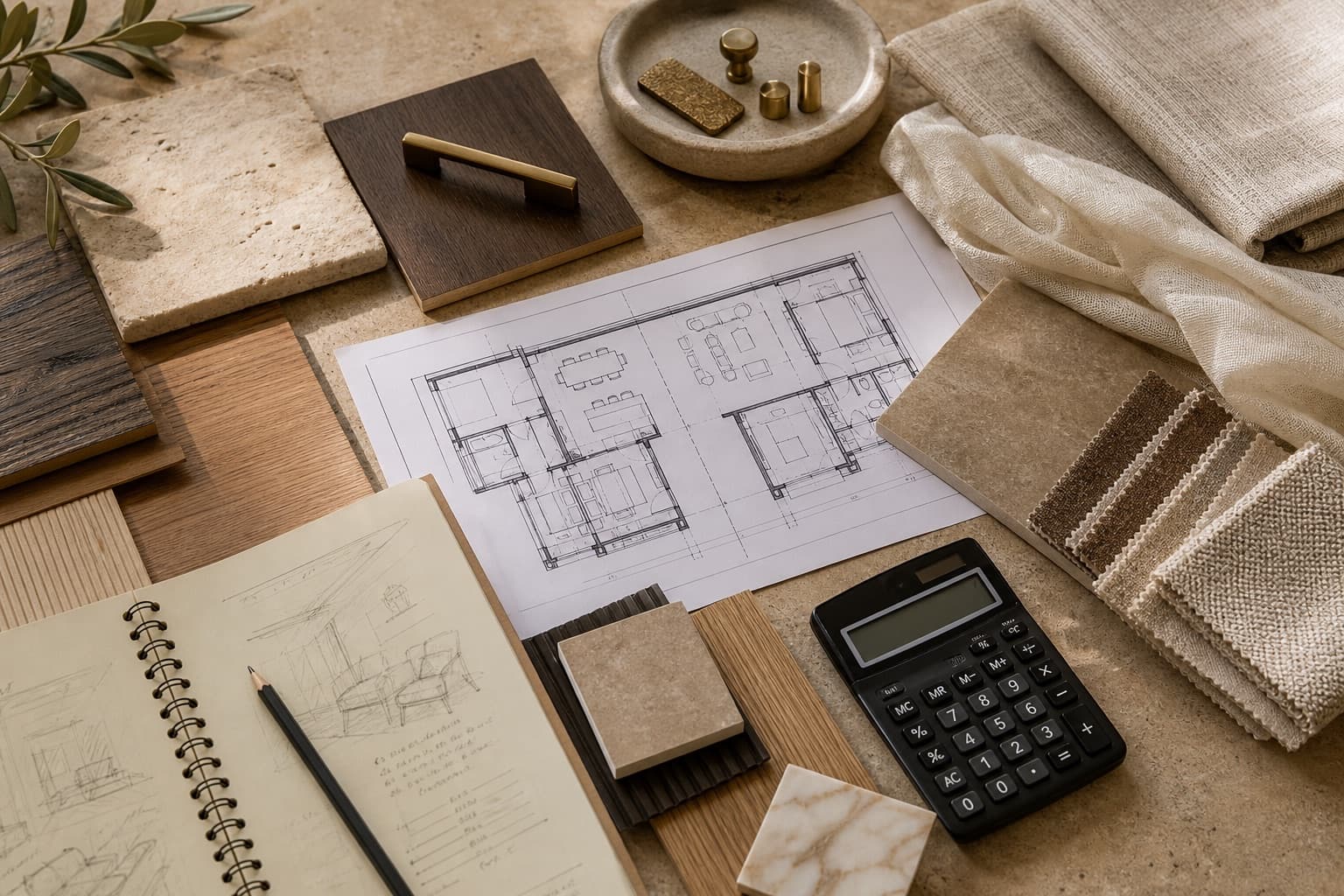
Forget exact figures for a moment and think in terms of where your budget gets spent. Every full-home project, mid-range or high-end, splits across the same categories. Knowing them is what lets you push spend toward what you care about and trim what you don't.
Design direction and drawings. The thinking and the paperwork: concept, layouts, visuals, material choices, and the technical drawings the trades build from. It feels like the easiest thing to skip. It's actually what protects every other dirham you spend, because it's what stops costly mistakes on site.
Furniture and the loose pieces. Sofas, beds, tables, chairs, rugs. This is usually the largest part of the budget and the one you have the most control over, because the range between a sensible piece and a showpiece is enormous. A room furnished thoughtfully from somewhere like Pan Emirates or The One can look every bit as considered as one filled with imported names. The skill is in the choosing and the mix, not the price tags.
Joinery and built-ins. Wardrobes, the kitchen, the TV wall, the walk-in closet. This is built to your drawings in a local workshop, and it's where a home stops looking furnished and starts looking designed. It's also a category where smart design beats raw spend: a well-planned wardrobe in a good finish reads far better than an expensive one that fights the room.
Lighting. Two parts, and people forget the second. There are the fittings you see, and there's the lighting built into ceilings and coves plus the electrical work behind it. Lighting does more for how a home feels than almost anything else per dirham, which makes it one of the best places to spend a little extra.
Curtains and soft furnishings. Curtains, blinds, cushions, upholstery. Quietly larger than people expect, because made-to-measure across a whole home adds up. Easy to underestimate, easy to leave till last, and worth planning early.
Materials and finishes. Flooring, tiling, wall finishes, the surfaces everything sits on. Hugely variable, and a place where good choices save real money. A well-chosen porcelain can carry a room that doesn't need stone, and most rooms don't.
Contractor and installation work. The trades who do the actual work: electrical and plumbing changes, ceilings, painting, tiling, and the crews who fit the joinery and hang the lights. This is real money and it's the line cheap quotes keep thin so the headline looks attractive.
Delivery, coordination, and project management. The least glamorous line and the one that decides whether you finish on time. Someone has to run the trades, schedule deliveries, and chase the snags. When this is missing, the someone is you, and that's how a four-month project becomes a year.
Townhouse versus villa: where the gap comes from
A townhouse isn't a small villa, it's a smaller job in every category. Fewer bedrooms, a tighter footprint, less of everything, so the total naturally sits lower. That's good news if you're in a townhouse and worried the numbers you've seen online apply to you. They mostly don't.
Villas scale up, and sometimes not in proportion. More rooms, bigger kitchens, a majlis, outdoor areas, the occasional double-height space that looks wonderful and quietly adds cost in tall curtains, painting access, and lighting. Homes in communities like Dubai Hills Estate and Tilal Al Ghaf also tend to carry a higher expectation on finish, which nudges the spec up unless you decide otherwise on purpose.
Where people underestimate
A few honest traps, because nearly everyone hits at least one.
Curtains and lighting together. On their own they feel minor. Across a whole home they add up to more than people plan for, and they tend to arrive late when the budget already feels tight.
The piece you saw versus the piece you can have soon. The sofa you fell for might be a long wait from overseas. The one available now costs more or compromises the look. That tension is a budget decision even though no quote names it.
Changing your mind on site. Once the drawings are signed and the workshop has cut the wood, a change means re-ordering or re-making, and that's rarely free. It's not a penalty, it's just the cost of undoing work that was already done correctly.
The cost of time. A project that drags isn't only frustrating. If you're renting while you wait, every extra month is real money no quote ever mentions.
What to ask before you approve a quote
Before you sign, get clear answers to these. A good designer will give them without flinching.
Is this one number, or a starting number? Ask plainly whether it can move, and what would move it.
What's included, and what's quoted separately? Furniture, curtains, lighting installation, and contractor work are the usual things hiding just outside the headline.
Who manages the trades and deliveries, and is that cost in here? If the answer is vague, the answer is you.
What's the finish date, and what happens if it slips? A date with no consequence attached is a wish, not a commitment.
How are changes priced? You want the rules before you're tempted to break them.
If a quote can't survive these five questions, that tells you something useful before you've spent anything.
How Ritzy handles the part that usually goes wrong
The thing that breaks most projects isn't taste or budget, it's the number and the date both quietly moving after you've committed. So Ritzy works differently: one price and one finish date, agreed in writing before any work starts. The scope is set up front, the number holds, and the date holds. For anyone who's heard the Dubai renovation horror stories, that's usually the part that matters most.
If you'd like to dip a toe before planning anything big, the Ritzy Studio app turns a single room into an AI-assisted design concept for a small fee, which is a low-pressure way to see how your space could work. You can see how the studio thinks on the process page, and browse design concepts on the work page. Those visuals are 3D design concepts rather than photos of finished homes, so you're seeing the intent and the direction.
Where to start
If you're trying to work out whether your plans and your budget actually line up, the most useful first step is a proper conversation with someone who prices these homes for a living. Ritzy offers a free 30-minute consultation with a member of our creative team, where you can talk through your home, what matters most to you, and a realistic plan for getting there. You'll come away clearer either way. Book it on the contact page, and if you want to see which communities the studio works across, that's a good place to start.
FAQ
How much does interior design cost for a villa in Dubai? There's no single price, because villa cost depends on size, how much custom joinery you want, your furniture choices, and the level of finish. The more useful question is what you want to prioritise. A villa can be designed to a genuinely high standard on a sensible budget when the spending is directed at the right things, and a good designer will help you decide where that is.
Is interior design only worth it for expensive homes? No. Design arguably matters more on a careful budget, because every choice has to earn its place. A designer's job is to make a mid-range budget look considered and intentional, not to spend the most money possible. The value is in the decisions, not the price of the furniture.
Can I use furniture from regular Dubai stores and still get a designed look? Yes, and most well-designed Dubai homes do exactly that. The look comes from layout, proportion, lighting, and how pieces are combined, far more than from any single label. Stores most people already shop at can absolutely deliver a pulled-together home in the right hands.
Why is interior design expensive in Dubai? A few reasons: a lot of furniture and materials are imported and carry shipping and lead times, the work is done by proper trade crews rather than cheap labour, and the homes are large. The coordination of all those moving parts is also a real cost, even though it's invisible on a quote.
Can I get a quote that won't change later? Yes, if the scope is defined properly up front. Ritzy works on a fixed price and fixed finish date, both agreed in writing before work begins. The key with any designer is making sure furniture, curtains, lighting installation, and contractor work are all inside the number rather than billed separately later.